
Knives Over Forks—Really?
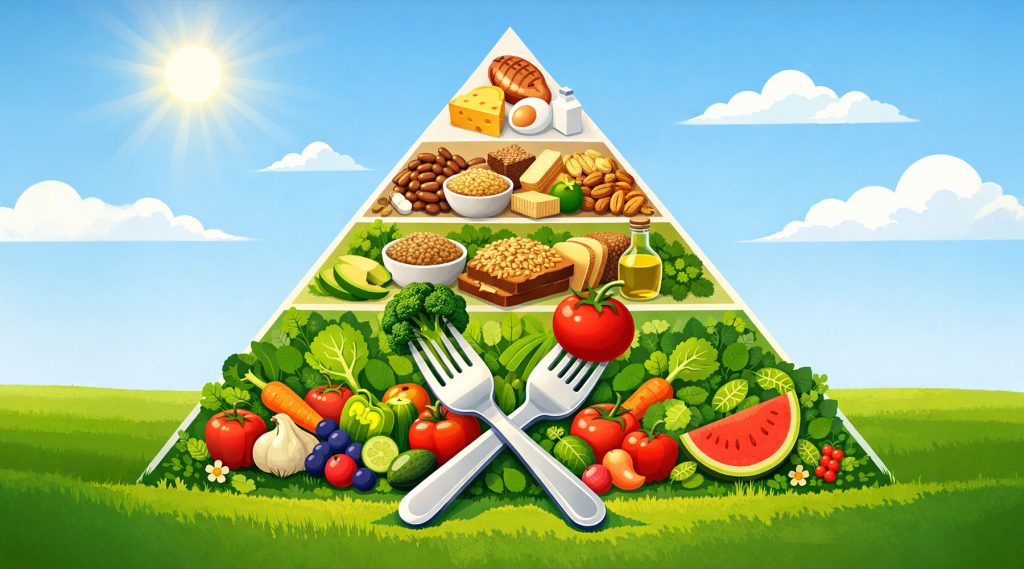
An inverted pyramid representing the newest diet recommendations by the U.S. Departments of Health and Human Services and Agriculture has sparked everything from celebration to confusion to outright criticism. In fact, the Dietary Guidelines for Americans (DGA) released on January 7, 2026, have probably generated more backlash than any food guidelines in U.S. history.
While hitting the bullseye on avoiding added sugar and refined foods, the guidelines also made some startling recommendations regarding animal-based fats and protein, placing them at a priority level in the pyramid. For instance, recommendations were made for frying foods in beef tallow or dairy butter as an alternative to olive oil. And in the accompanying graphic, meats and full-fat dairy are shown at the top along with vegetables.
Physicians, Dietitians & Researchers
Since the new pyramid and guidelines were released, a tsunami of comments has flooded the media from physicians, dietitians, and researchers concerned about the potential impact on public health. While many acknowledge the positives in the new DGA, there are significant misgivings about several aspects of the new advice.
One of the most frequently cited issues is the confusion generated by the apparent contradiction between the Food Pyramid graphic and the written guidelines. Even a dietitian writing for the Food Network expressed concern that the new recommendations could result in more Americans consuming excessive saturated fat from animal products, potentially endangering their health.
Major health organizations have echoed these concerns. For instance, the American Heart Association applauded some of the changes but cautioned that the new emphasis on animal fats and meat consumption could cause many people to consume an excess of saturated fats, which could result in increased rates of cardiovascular disease.
Experts who participated in the guideline process have also raised red flags. Deirdre Tobias, one of three Harvard nutrition professors appointed to the DGA Advisory Committee, commented that the “biggest deviation from the science is a new prioritization of animal sources within the protein food group, instead of a plant-forward pattern.”
“The Guidelines err in promoting meat and dairy products, which are principal drivers of cardiovascular disease, diabetes, and obesity.”
Those advocating for plant-based health have been even more direct. The Physicians Committee for Responsible Medicine—an organization of nearly a million members, including 17,000 physicians—supports plant-based eating because of the extensive evidence demonstrating its health benefits. Neal Barnard, president of the Physicians Committee, commented regarding the DGA: “The Guidelines are right to limit cholesterol-raising saturated (“bad”) fat, but they should spell out where it comes from: dairy products and meat, primarily. … The Guidelines err in promoting meat and dairy products, which are principal drivers of cardiovascular disease, diabetes, and obesity.”
Dr. Barnard’s critique carries weight. He has led dozens of scientific research studies on the effects of diet on chronic pain, hormonal symptoms, body weight, and diabetes. One of his studies, funded by the National Institutes of Health, opened the way for the discovery that type 2 diabetes can potentially be reversed.
Decades of Research
Beginning in the 1960s, prominent physicians and researchers such as Dr. Colin Campbell and Dr. Caldwell Esselstyn (whose work inspired the hit documentary Forks Over Knives) began investigating the effects of diet on health. In one landmark study, Dr. Esselstyn changed the diets of patients with severe cardiovascular disease (CVD) to a whole foods, plant-based pattern. Those who adhered to the diet experienced no further cardiac events during the 12 years of follow-up. The one patient who did not stick with plant foods required bypass surgery six years later. A larger study followed, delivering similar results and confirming the potential power of dietary change. In the 1990s and beyond, Dr. Dean Ornish reported comparable outcomes with his own program to reverse heart disease that featured plant-based eating. This added additional evidence that dietary intervention can dramatically change the outcome for CVD patients.
One of the largest studies along these lines—a meta-analysis of 19 studies involving well over one million participants—examined the association between dietary fat and various causes of death. This extensive analysis produced a broad view of how different types of fat influence long-term health outcomes. The researchers concluded: “Diets high in saturated fat were associated with higher mortality from all-causes, CVD, and cancer, whereas diets high in polyunsaturated fat were associated with lower mortality from all-causes, CVD, and cancer. Diets high in trans-fat were associated with higher mortality from all-causes and CVD. Diets high in monounsaturated fat were associated with lower all-cause mortality.”
Together, these results reinforce what decades of additional empirical research have shown: that dietary patterns emphasizing whole foods and plant-based nutrition consistently align with lower disease risk and improved health. Even with this impressive collection of research backing up the benefits of a whole foods, plant-based diet, the controversy continues—not among most researchers, but among those determined to oppose or reinterpret the science. Yet, the science itself remains clear.
It has taken us humans a long time to sort out the healthiest approaches to eating, but God laid out the original plan in His Word millennia ago. “See, I have given you every herb that yields seed which is on the face of all the earth, and every tree whose fruit yields seed; to you it shall be for food” (Genesis 1:29). In other words, from the very beginning, the Creator provided a vast variety of plants as food for all living things—a generous, abundant menu designed for our wellbeing. Delicious fruits, seeds, nuts, greens, grains, legumes, and vegetables are all part of His health-enhancing plan for us, a plan that still speaks with wisdom today.
Want to learn how to improve your health? Read our free Study Guide called “God’s Free Health Plan”!
More on AF Blog

Trapped With a Deadly Virus
The cruise ship MV Hondius has captured worldwide attention as its passengers became infected with…

Religious Liberty at a Crossroads: Why It Still Matters
As the U.S. government and mainstream Christianity seem to be growing closer in today’s headlines,…

Artemis II: Beyond the Moon
Humans aboard the Orion spacecraft recently circled the moon, venturing farther into space than ever…

Social Media Addiction and the Christian
Recent court rulings against Meta and YouTube highlight growing concern over social media’s addictive design…
Back to the Garden: An Edenic Approach to Colorectal Cancer Prevention
Colorectal cancer rates are surging in adults under 50, and modern diets are a driving…