
Still Here? What the Bible Says About Date-Setting and the Rapture

This week, a startling claim rocketed across social media with such noise that even mainstream news outlets reported on it: The Rapture, the moment when Christian believers will supposedly be snapped from the earth to meet Jesus, could happen today, Wednesday, September 24. (It also could have happened yesterday.)
Yahoo’s news coverage named Pastor Joshua Mhlakela, a preacher in South Africa, as the would-be prophet this time around. An earlier interview of his resurfaced and sparked the “RaptureTok” trend, with many asking if late September marks the end as we know it.
Several outlets also noted that these dates coincide with Rosh Hashanah (the Feast of Trumpets), which many popular teachers try to connect with end-time events.
What Is the Rapture?
The word “rapture” doesn’t appear in the New King James Bible; it is derived from the apostle Paul’s phrase “caught up” in 1 Thessalonians 4:17. Although the roots of this teaching are found in the Catholic Jesuit tradition, the doctrine gained traction in the 19th century writings of John Nelson Darby and became immensely popular among evangelicals through the Left Behind books and films. It teaches that believers will suddenly disappear from sight, without any warning—a silent Second Coming.
The Bible certainly affirms the hope of Christ’s literal return and that God’s people will indeed be gathered to Him (1 Thessalonians 4:16, 17), but it presents this climactic event as anything but secret. It is audible (“with the trumpet of God”), visible (“every eye will see Him,” Revelation 1:7), and world‑shaking (2 Peter 3:10).
The dead in Christ will be raised at His coming (1 Corinthians 15:51, 52), and the living righteous will be transformed to meet the Lord together with them.
This is no quiet vanishing; it is the triumphant arrival of the King!
Date‑Setting Is Dangerous
Scripture also does not authorize anyone to set a date for the Lord’s return.
Jesus’ own warning is plain: “But of that day and hour no one knows, not even the angels of heaven, but My Father only” (Matthew 24:36).
“But of that day and hour no one knows.”
When the apostles pressed the risen Christ for a prophetic timetable, He replied, “It is not for you to know times or seasons which the Father has put in His own authority” (Acts 1:7).
Setting dates does more than disobey a clear command; it misdirects faith from a life of daily readiness to a countdown clock that will surely disappoint.
It seems that many haven’t learned enough from history. Highly publicized predictions have come and gone repeatedly. Harold Camping’s 2011 dates are still fresh in our collective memory—and each failure leaves confusion, cynicism, and wounded believers in its wake. Earlier generations experienced similar waves, such as the mass-market booklet “88 Reasons Why the Rapture Will Be in 1988.”
The pattern is consistent: confident calculations, eyebrow-raising headlines, and then the ache of spiritual letdown when the sun rises the next day.
Some are pointing to the symbolism of the Feast of Trumpets to justify this week’s prediction. While Christians should cherish the typology of the sanctuary and the feasts, their clear work is to point us to Jesus’ saving work and the certainty of His return—not to a date on our calendar. We would do well not to step outside the guardrails Jesus Himself gave.
The Bible’s Counsel
What should Christians longing for the hope of Jesus’ return be doing instead of date-setting?
1) Stay awake spiritually. “Watch therefore, for you do not know what hour your Lord is coming” (Matthew 24:42). Readiness isn’t about a circled date; it’s about a relationship—abiding in Christ every day (John 15:5).
2) Hold fast to the blessed hope. Paul anchors our hope in the resurrection at Christ’s coming (1 Thessalonians 4:13–18). Notice his aim: “comfort one another with these words.”
3) Test all claims by the Bible. Jesus warned of “false christs and false prophets” and sensational rumors (Matthew 24:23–27). The true Second Coming needs no “influencer” push—it will be unmistakable, global, and glorious.
4) Be mission-minded while we wait. Peter says the apparent delay is mercy, giving time for repentance (2 Peter 3:9). The right response to end‑time expectation is service, not speculation.
Safeguard Your Hope
This most recent date-setting snowballed on social media after a previously posted interview gained traction—another example of how algorithms and going viral can take a fringe claim and fling it into the mainstream conversation overnight.
When that happens, Christians have an opportunity to gently redirect attention from clicky predictions to the clear promises of the Bible.
It’s worth noting how often such predictions cluster around attention‑grabbing moments (eclipses, blood moons, feast days, election cycles). It’s also important to know the truth about the state of the dead: Those who’ve died in Christ are resting—awaiting the resurrection—not watching the news or whispering dates to anyone alive on Earth (Ecclesiastes 9:5, 6; John 5:28, 29).
So, Is the Rapture Happening?
It’s far safer to set aside the social media trends and embrace the Bible’s clear word: “Of that day and hour no one knows” (Matthew 24:36). That single sentence answers the headlines. We don’t know the day; we do know the Savior. The same passage urges readiness, faithfulness, and love—qualities that will matter just as much today, if Jesus comes, as they will tomorrow, if He tarries.
This week’s viral prediction will likely fade as others have. But your hope doesn’t have to. Anchor it where Scripture anchors it: in the risen Lord who is coming again and who promises, “I will come again and receive you to Myself” (John 14:3).
For more, read our FREE Bible study, “The Coming King.”
More on AF Blog

War With Iran and Armageddon
The United States and Israel attacked Iran in a bid to eliminate its nuclear program…

Is AI Eroding Your Emotional Health?
Over the past several months, a growing number of studies have suggested an association between…

Faith Against the Screen: A Century of TV Versus God’s Eternal Word
For 100 years now, video content has been shaping our desires and dulling moral judgment.…

Knives Over Forks—Really?
Amid the conflict and confusion surrounding the new food pyramid, there are mountains of evidence…
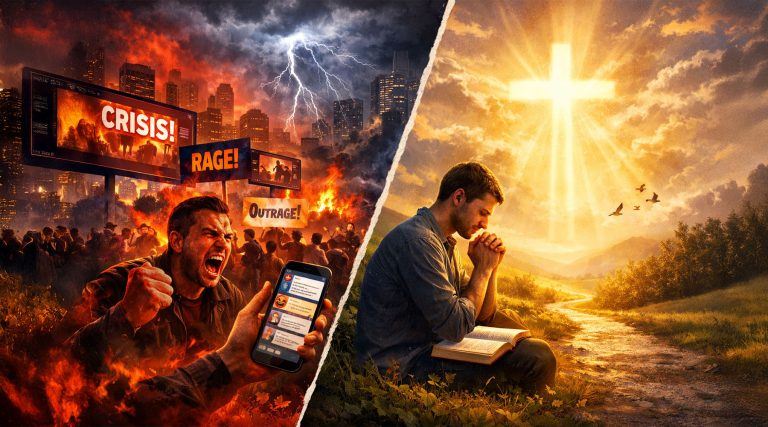
2026: Rage Bait … or Inexpressible Joy?
The year 2025 was one of escalating tensions—between nations, cultures, and individuals. Events seemed calculated…