
Faith Against the Screen: A Century of TV Versus God’s Eternal Word
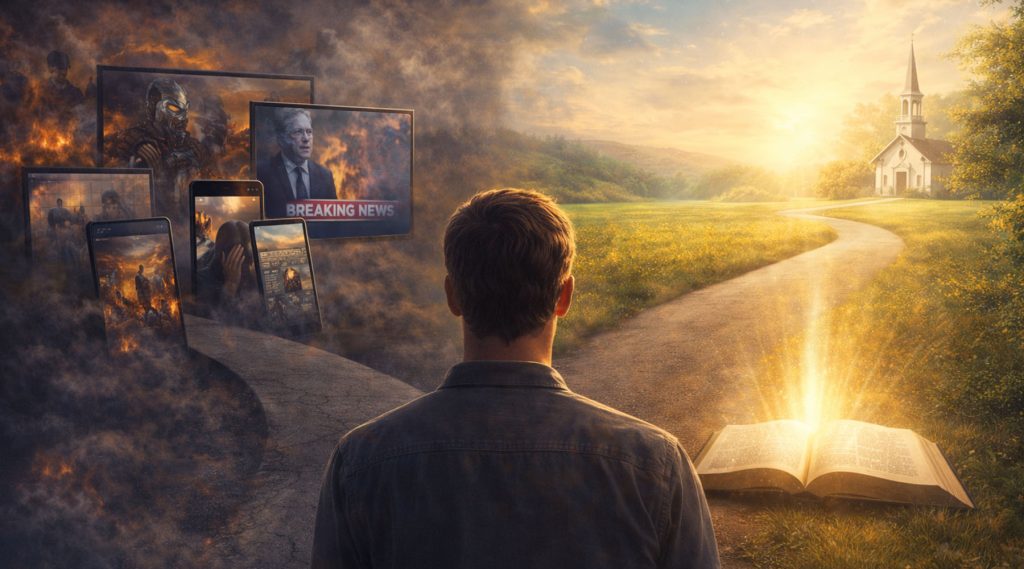
On January 26, 1926, a Scottish inventor named John Logie Baird invited a small audience to witness something never seen before: moving images transmitted electronically. It was the world’s first live public television broadcast. At the time, no one could have foreseen how much this event would alter all aspects of modern living.
One hundred years later, television—and by extension all video-based social media platforms—dominates our daily routines. Screens wake us up, keep us company during meals, follow us into our bedrooms, and shape how we relax, learn, and view the world.
According to recent studies, the average American spends 5.5 hours per day watching TV/video content, and the average teenager consumes a staggering 9 hours of entertainment media per day (not including time spent using media for school or homework). On the other hand, only 16 percent of Americans say they read their Bible every day.
That contrast is striking.
Screens: A Powerful but Neutral Tool
To be clear, television and digital media are not inherently evil. Like fire or electricity, they are tools—powerful ones—that can be used for good or for harm. Educational programs have taught generations to read. Documentaries have expanded our understanding of the world. Sermons, Bible studies, and other faith-based content now reach millions at the tap of a screen.
The problem isn’t that we watch—it’s what we watch, how much we watch, and what we prioritize spending our time on.
Even the briefest look at any of today’s most popular TV channels or social media platforms will instantly reveal that the more inflammatory and salacious a video, the more popular it is. According to an article published in Forbes: “The algorithm doesn’t reward truth—it rewards hostility. If an accurate news report gets less engagement than a sensationalized falsehood, the falsehood wins.”
This doesn’t just apply to news, but to all forms of video content. Provocation reigns, and outrage is all the rage. What we consume to unwind winds up leaving us anxious, overstimulated, and numb instead.
It’s even more dire when it comes to developing minds. “Today’s children and teens do not know a world without digital technology, but the digital world wasn’t built with children’s healthy mental development in mind,” states the American Academy of Pediatrics.
So how can we find our way in a world saturated with digital noise?
Choose Light, Not Darkness
The Bible tells us “there is nothing new under the sun” (Ecclesiastes 1:9). Television may be only a century old, but distraction and misinformation have always been the enemy’s primary tools. Entertainment is nothing but the same tactic in different packaging.
What we consistently take in doesn’t stay on the outside. It shapes our values, trains our desires, and influences our minds. A 2023 study found that repeated exposure to wrongdoing—known as the moral repetition effect—dulls our emotional response, so each time we see it, we judge it as less unethical, gradually reshaping our moral compass.
Is it any wonder Satan relentlessly uses our screens to flood our lives with corrupting content?
It’s for this very reason that Jesus warned us: “The lamp of the body is the eye. If therefore your eye is good, your whole body will be full of light. But if your eye is bad, your whole body will be full of darkness” (Matthew 6:22, 23).
What we give our time, attention, and affection to doesn’t just fill our schedule—it forms our hearts. If our daily diet is mostly trivial, violent, or hopeless content, our spiritual and mental lives will reflect it. Fortunately, God has given us the gift of choice, as He says, “Behold, I stand at the door and knock. If anyone hears My voice and opens the door, I will come in to him and dine with him, and he with Me” (Revelation 3:20).
Reject Satan’s fear and anxiety-inducing fare and choose to dine with Jesus.
Dining on Truth
In a digital world rife with chaos, every time we choose God-honoring media, we reject Satan’s fear and anxiety-inducing fare and choose to dine with Jesus. And although deciding what media to allow into our lives may seem like navigating a minefield, thankfully, we have a sure guide: God’s Word.
So what does biblical content look like? The apostle Paul’s words are especially helpful in making our viewing decisions: ”Whatever is true, whatever is noble, whatever is right, whatever is pure, whatever is lovely, whatever is admirable—if anything is excellent or praiseworthy—think about such things” (Philippians 4:8).
How’s your digital plate looking lately?
Exercising Divine Discernment
Here are three practical and biblical steps to help make faithful media choices.
- Pray: Before scrolling, watching, or listening, ask God to guide your choices. Prayer helps you filter content through His perspective. “If any of you lacks wisdom, let him ask of God, who gives to all liberally and without reproach, and it will be given to him” (James 1:5).
- Evaluate media against Scripture: Does it promote love, peace, integrity, and holiness—or does it entice and enflame? God invites us to think critically and align our choices with His Word: “Come now, and let us reason together, says the LORD” (Isaiah 1:18).
- Ask yourself if it draws you closer to God: Before watching anything, consider what it teaches you about Him. If the answer is nothing, it is likely not worth your time. “Let the words of my mouth and the meditation of my heart be acceptable in Your sight, O LORD, my strength and my Redeemer” (Psalm 19:14).
The Choice Is Yours
God’s Word has always been transformative—but never before has it been so accessible. Today, sermons, Bible studies, and faith-based programming can reach people across the globe instantly.
The question is whether we will choose media that merely entertains—or media that actually nourishes.
As we reflect on a century of television, this anniversary invites us to ask an honest question: How are my viewing choices shaping my thoughts?
It may not be necessary to turn screens off entirely, but to intentionally turn them to something better.
Learn to understand the Bible and sharpen your spiritual discernment with Pastor Doug’s free book, The Ultimate Resource.
More on AF Blog
Knives Over Forks—Really?
Amid the conflict and confusion surrounding the new food pyramid, there are mountains of evidence…

2026: Rage Bait … or Inexpressible Joy?
The year 2025 was one of escalating tensions—between nations, cultures, and individuals. Events seemed calculated…

Hell and Mr. Cameron
Former television star and outspoken Christian, Kirk Cameron, is taking heat for changing his view…

Are Digital IDs the Mark of the Beast?
Many people worry that digital identification systems are the mark of the beast. But the…

Marian Statue Attracts Thousands
Thousands flocked to the dedication of the world’s largest statue of the Virgin Mary. Learn…