
Free Book Library
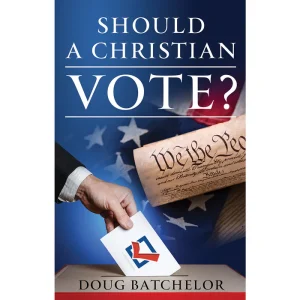
Should a Christian Vote?
An Amazing Fact: William Henry Harrison, ninth president of the United States, was elected in November 1840 after an especially contentious election season. On the day of his inauguration—March 4, 1841— it was cold and wet in Washington, D.C. Even though others urged Harrison to wear a coat and a hat, he refused. Furthermore, he chose to ride to the inauguration on horseback rather than in a carriage.
Harrison had been a well-known, successful general, and perhaps he felt tough enough to endure the elements. That day, he also delivered the longest inaugural speech of any president. During the two-hour discourse, the light rain turned to snow. By the time Harrison had mounted his horse and ridden in the inaugural parade, he was drenched. The rest of his day and evening were spent attending three inaugural balls, the last one at a saloon.
Only weeks later, he again found himself in prolonged outdoors in terrible weather and caught a cold. This illness eventually turned into pneumonia, and Harrison died on April 4. One month was a very short presidential term. Because he was in office for only 31 days, it is said that he had the most honest administration of any president. But the hopes of his supporters were dashed by his untimely death.
A Question of Trust
This outcome reminds us that humans, even our leaders, are mortal. Indeed, the Bible advises, “Do not put your trust in princes, nor in a son of man, in whom there is no help. His spirit departs, he returns to his earth; in that very day his plans perish” (Psalm 146:3, 4). No human leader can save us. So as we consider the subject of elections, ultimately we need to know that the Lord is the only One who can save us.
However, it’s important to understand that David’s words in Psalm 146 are not meant to be a blanket statement that we should never trust anyone in government—even though some use the verse in that way. Others quote Jeremiah 17:5: “Cursed is the man who trusts in man and makes flesh his strength,” except they neglect to read the rest of the passage, which concludes, “whose heart departs from the Lord.” Notice that the curse is on those whose hearts turn away from God.
It is not a sin to trust others, even if they work in government. After all, wasn’t Daniel in government? What about Nehemiah, Joseph, and Mordecai? God has often had trustworthy people in civil positions of leadership. Sometimes we become a little cynical about anyone connected to government work, knowing that there is significant corruption in politics. Yet we continue to select our leaders through the process that was chosen by the Founding Fathers.
Given the fact that no candidate is the supreme answer for the woes of the world, how should we as Christians relate to politics and our election process? As a pastor, during big election years, I often get asked questions like: Should Christians vote? Since there’s so much corruption, should we just run the other direction?
Others believe that we should use our influence for good to the extent that every church become a platform for debate and a polling station for voting. You would be amazed to discover how good Christian people are “polls” apart (pardon the pun) on this issue.
After praying and studying about how Christians should relate to voting for public officials—even delving into my own church’s history—I’d like to share some insights in this short book. At the time of this writing in 2020, we are, in the United States, in the throes of another intense—and, at times, dangerously inflammatory—political season. Please remember that this is in no way an endorsement for any party or person. In the following pages, I’ll focus on some principles about how we should relate to the government, particularly in the area of exercising our right to vote.
Citizens of Another Kingdom
First and foremost, we need to remember that as Christians, we are primarily citizens of another kingdom. During His trial before Pilate, Jesus stated this plainly: “My kingdom is not of this world. If My kingdom were of this world, My servants would fight, so that I should not be delivered to the Jews; but now My kingdom is not from here” (John 18:36).
Notice that He said His kingdom is not from here. However, will Jesus someday reign supreme on this planet? We know from Scripture that He will. (See Revelation 11:15.) But currently, there’s a contest in our world between two opposing leaders—Christ and Satan.
Jesus explained to His disciples, “The kingdom of God does not come with observation; nor will they say, ‘See here!’ or ‘See there!’ For indeed, the kingdom of God is within you” (Luke 17:20, 21). God’s kingdom begins inside us when we allow Jesus to reign in our hearts. He must first be Lord and King within us.
That being said, is there anything wrong with a Christian having some feelings or ideals of patriotism toward their country? I think not. In our travels, my wife, Karen, and I have enjoyed meeting people in many parts of the world, and they are generally quite happy to tell us about their heritage. Loving the country from which you come is natural.
Moreover, feeling protective about your nation certainly isn’t wrong nor is feeling an emotional attachment to your homeland. How did Jesus feel? Didn’t He lament, “O Jerusalem, Jerusalem”? (Matthew 23:37).
King David expressed the sentiments of those who were carried away from their homeland to the foreign country of Babylon. He writes of the Jews’ grieving, “How shall we sing the Lord’s song in a foreign land? If I forget you, O Jerusalem, let my right hand forget its skill! If I do not remember you, let my tongue cling to the roof of my mouth—if I do not exalt Jerusalem above my chief joy” (Psalm 137:4–6). Of course, Jerusalem was associated with their God, but the Jewish people were also devoted to their country as well.
Before Jacob died in Egypt, he gave explicit instructions to his sons to bury him in the country of his birth (Genesis 49:29). Why didn’t he want to be buried in Egypt, knowing that he eventually would be resurrected and receive a new body? It was because he had a natural attachment to the place from which he had come. On his deathbed, Joseph also implored the children of Israel to bury him back where he had been born (Genesis 50:25). He hadn’t lived in his homeland for nearly a century, yet he longed to be buried there.
I have observed this desire in my own family. After my dad left Oklahoma at age 15, he lived in a variety of places. Even though he had resided in Miami for 30 years, he requested that at his death his body be flown back to Oklahoma and be buried next to his folks.
We’re all wired for a little bit of patriotism. It doesn’t mean that our country does everything right or that we support all the choices our government makes, but to feel some loyalty to our country of origin isn’t always wrong. To some extent, it is very natural.
Voting Is Biblical
Did you know that the concept of voting is biblical? We’re going to explore this idea briefly, but first let’s look at the definition of the word “vote.” According to the dictionary, a vote is “[a] formal indication of a choice between two or more candidates or courses of action, expressed typically through a ballot or a show of hands or by voice.” 1 By that definition, we vote all the time— even in churches. We vote people into membership, we set up committees that nominate people, we sift down the choices, and then we elect people to serve in various capacities within the church.
In Old Testament times, Moses instructed the children of Israel to vote on leaders. “Choose wise, understanding, and knowledgeable men from among your tribes, and I will make them heads over you” (Deuteronomy 1:13). The people had to make “a formal indication of a choice.”
We see examples of voting in the New Testament as well. In Acts 1:23, when the apostles decided to find a replacement for Judas, “they proposed two: Joseph called Barsabas, who was surnamed Justus, and Matthias.” These men were not selected at random but were handpicked out of a group of faithful disciples who had personally known and been taught by Jesus. The passage then goes on to explain that Matthias was chosen by lot. While the final decision was left to God, it was the apostles who first had to choose the two men to be considered for the position. We are to work with God in determining our leaders. In modern terms, it would be as if the church members, using sound judgment, chose candidates and then prayerfully asked God for His guidance before appointing them to positions.
In another instance, the apostles needed to choose deacons to serve the church. Calling the disciples together, they said, “Seek out from among you seven men of good reputation, full of the Holy Spirit and wisdom, whom we may appoint over this business” (Acts 6:3). Eventually, they came up with seven names.
I’d like to point out that one of the seven deacons, Nicholas of Antioch, began making wrong choices and eventually left the church. So from then on, do you think the disciples concluded, “We’re not voting for anyone ever again because they could go bad”? No. That would have been unreasonable.
Think about it this way: Who made Lucifer? Was he ever a good angel? Yes! He was created perfectly by God. But his choice to rebel was his own. Who chose King Saul to be king? Now, it is true that the people said, “Give us a king” (1 Samuel 8:6), but they didn’t choose Saul. God did. And although Saul was filled with the Spirit for a while, pride eventually brought him down. Did God make a mistake? No. But He did allow Saul the freedom of choice.
The point is that we can’t say, “I’m never going to pick anybody for anything because who knows what they might do.” Are we really going to go through life without taking risks or giving anyone a chance? No, we need to make decisions by combining the facts we know at the time with specific prayer for God’s guidance, and then after the decision is made, continue to pray for those voted into office. As the apostle Paul advises, “I exhort first of all that supplications, prayers, intercessions, and giving of thanks be made for all men, for kings and all who are in authority, that we may lead a quiet and peaceable life in all godliness and reverence” (1 Timothy 2:1, 2).
In my church, the Seventh-day Adventist denomination, some have taken a quotation from an early church leader, Ellen White, to support the idea that we should not vote at all. When speaking about politicians who were pressing for Sunday laws, she said:
We cannot with safety vote for political parties; for we do not know whom we are voting for. We cannot with safety take part in any political schemes. We cannot labor to please men who will use their influence to repress religious liberty, and to set in operation oppressive measures to lead or compel their fellow men to keep Sunday as the Sabbath. … The people of God are not to vote to place such men in office; for when they do this, they are partakers with them of the sins which they commit while in office (Fundamentals of Christian Education, 475, my emphasis).
Yet it is essential that this quote be taken in context; her suggestion spoke of a specific issue and of certain politicians and addressed only a certain group of people, namely those in education. Her concluding point was that politics, like any other matter, should not take priority over our service to God. As we are to see, in her writings she made it clear that, in certain cases, participating in the vote was acting in the service of God.
Avoiding Disputes
Should Christians allow political parties to divide them? In answering this question, let’s look at both the history of our country and the history of my church to provide some context.
Political parties of the 1800s were extremely divided, much like today. In those days, people would often show up at church wearing buttons for the Republican Party, Whig Party, or Democratic Party. They campaigned in the aisles and broke out into disputes over politics—sometimes even before they knew who their candidate was. It was the political party they were fighting over, not issues or candidates.
It was while addressing this problem that Ellen White wrote in 1898, “We are not as a people to become mixed up with political questions. … Be ye not unequally yoked together with unbelievers in political strife, nor bind with them in their attachments. … Keep your voting to yourself ” (Selected Messages, Book 2, 336–337).
In other words, don’t feel it’s your duty to urge everyone to vote as you do. Each of us has free choice and must contend with his or her own conscience. This counsel is directed against getting involved in political parties for the party’s sake—something that, as Christians, we should avoid.
Within my denomination—and virtually every denomination—there are people supporting a variety of political parties. We need to tread lightly in this area. When we come together as Christians, we should never be divided by political barriers. We need to be united in love.
Consider Paul’s admonition in 1 Corinthians 3:3, 4: “For you are still carnal. For where there are envy, strife, and divisions among you, are you not carnal and behaving like mere men? For when one says, ‘I am of Paul,’ and another, ‘I am of Apollos,’ are you not carnal?”
Believers in Paul’s day were lining up behind different apostles and turning their faith into a political campaign. It was dividing the church, and Paul rebuked them for it.
He also counseled believers not to judge one another based on personal choices, saying, “Who are you to judge another’s servant? To his own master he stands or falls” (Romans 14:4). When others bring up politics, it’s best to sidestep disputes. For instance, when someone says to you, “I’m convinced about this political view” or “I’m voting this way,” you can respond, “Praise God we’re in America and we’re free to make those choices.” That person’s choice is his choice. To his own master he will stand or fall.
In private conversations with friends, it can sometimes be mentally invigorating to talk a little bit about politics. In the church, however, that subject can so easily become divisive. We as Christians are to guard against sowing seeds of discontent and discord. “Every city or house divided against itself will not stand” (Matthew 12:25). When we come into God’s house, we are all brothers and sisters and need to take care to reverence our time of worship, faithfully remembering that we are one in Christ.
A Moral Obligation
When it comes to moral issues, I do believe that it is important for Christians to take responsibility and vote for the principles that we support. Voting demonstrates that we respect the authority of the political system in our nation. Our leaders, whether good or bad, are chosen by the people. And despite all that you hear in the press about how values are changing—and they are changing—we are still a predominantly religious country. Seventy percent of Americans still claim Christianity as their religion, yet if Christians don’t represent their values in the government, then to some degree they’re going to get what they deserve.
According to Scripture, we should have respect for our government. Paul says in Romans 13:1, 2: “Let every soul be subject to the governing authorities. For there is no authority except from God, and the authorities that exist are appointed by God. Therefore whoever resists the authority resists the ordinance of God, and those who resist will bring judgment on themselves.” He also instructs us, “Render therefore to all their due: taxes to whom taxes are due, customs to whom customs, fear to whom fear, honor to whom honor” (v. 7).
In other words, we should be faithful to fulfill our civic duties, whether it’s taxes or whether it’s sharing in our neighborhood association what materials should be used on the roof of our houses.
The Seventh-day Adventist Church Manual shares some basic principles regarding our responsibility as citizens: “We should be recognized as outstanding citizens … in working for the common good [and] … for social order and betterment[,] … [maintaining] an uncompromising stand for justice and right in civic affairs” (p. 143).
Voting for right principles is one way we can obey God’s command to seek the good of those around us and our nation as a whole. Do you realize that there was actually a time when the American people had to decide between voting for one party that was against slavery and one that was for it? Should Christians have been involved in such matters? That’s a resounding yes! Sometimes you need to vote for the person who represents the principle you know is right.
I believe that we can gain some valuable insights from church history. In the early days of the Adventist Church, for example, James White wrote, “Those of our people who voted at all at the last Presidential election, to a man voted for Abraham Lincoln. We know of not one man among Seventh-day Adventists who has the least sympathy for secession.” 2 At a time when antagonism over slavery was heavily fueling a future civil war in the United States, our church members participated on a moral issue.
In 1865, at the third session of the General Conference, at which J.N. Andrews, Uriah Smith, and James and Ellen White—among other prominent Adventist leaders—were participating, a third resolution involved the subject of voting:
RESOLVED, That in our judgment, the act of voting when exercised in behalf of justice, humanity and right, is in itself blameless, and may be at some times highly proper; but that the casting of any vote that shall strengthen the cause of such crimes as intemperance, insurrection, and slavery, we regard as highly criminal in the sight of Heaven. 3
This was a strong statement. The resolution also spoke against “any participation in the spirit of party strife.” It made a clear distinction between the exercising of a voting right and campaigning for a particular party in the church.
In 1881, Adventists gathered for a camp meeting in Iowa and a resolution concerning prohibition was placed before the delegates. Alcohol was the drug of choice in those days, and saloons were rampant. Without the protection services that we have today, families were suffering immensely. Many women were beaten, and kids were left destitute. Those concerned wanted a law to remove this evil from their towns, and some felt very passionate about it.
The camp meeting resolution expressed “deep interest in the temperance movement.” 4 It encouraged every member to act “in favor of the prohibitory amendment of the Constitution,” which included voting. But some disagreed with the clause regarding the ballot box and urged that it be taken out.
Finally, Ellen White was called upon to share her thoughts. “I was to speak to the point of whether our people should vote for prohibition,” she wrote on the matter. “I told them ‘yes,’ and spoke twenty minutes” (Temperance, 255). Moreover, in her diary she penned,
Men of intemperance have been in the office today in a flattering manner expressing their approbation of the course of the Sabbathkeepers not voting and expressed hopes that they will stick to their course and like the Quakers, not cast their vote. Satan and his evil angels are busy at this time, and he has workers upon the earth. May Satan be disappointed, is my prayer (256).
And in a personal letter, she even added, “If necessary, vote on the Sabbath day for prohibition if you cannot at any other time” (Women of Vision, 203). That’s how important she considered the issue!
When rebellious Israel was defeated and her people seized by Babylon, God told the Israelites to settle there, cultivate the land, and multiply their families. And then He went on to say, “Seek the peace of the city where I have caused you to be carried away captive” (Jeremiah 29:7). Though in a foreign land, they were citizens of that country, and God instructed them to be good citizens, to pray for the peace of that country because, after all, what happened there would undoubtedly affect them.
What happens to our country is undoubtedly going to affect our lives too, so it would behoove us to be very interested in what happens while we’re still here. Again, as Americans and as Christians, we have dual citizenship. As children of Christ, we are principally from the kingdom of God, but that still means we’ve got to occupy a foreign land until He returns.
The very word “Adventist” means that someone believes in the return of Christ.
During the very earliest years of my church, members looked for the immediate coming of the Lord. When someone asked an Adventist then, “Who are you going to vote for?”, the typical response was, “I don’t care; Jesus is coming.” The prevailing attitude was, “We don’t want to get involved in politics; don’t worry about voting. We’ll soon be in heaven.” But time lasted longer than they expected.
Over forty years ago, I built my first house in California. I was 19 years old, and I had to choose between using wooden blocks or concrete for the foundation. I decided to use oak blocks, certain that Jesus would come before they rotted. Well, they rotted long ago, and the house began to list. We finally burned it down.
Have you ever thought that Jesus would have come before now? Don’t use oak blocks in your planning. As a Christian, you should plan as though you are living on earth for another 100 years—but live as though Jesus might come tomorrow.
We need to consider others in our voting, including our descendants. What kind of world are we going to have should time last? Should we care? Think about the reason you’re free now. It’s partly because people died for your freedom in World War I and World War II, right? People before us have invested their lives to make our country better. Their hard-fought choices have kept us, their descendants, free. Should we not do the same for those who may come after us?
As Christians, we ought to be passionate about voting for principles and policies that will help us maintain the freedom to practice and to proclaim our faith. If the people running for office intend to restrict our freedom to proclaim the gospel or to practice our religion, that should be to us a major concern.
Some people have the attitude, “Our world is going to end, and everyone’s going to die, so who cares what happens to our nation?” They figure the quicker it ends, the better. Have you met people like that? With that reasoning, we should probably all go out and lobby for Sunday laws and get it over with, right? But that wouldn’t make sense! Shouldn’t we try to prolong the freedom to proclaim the gospel so as many as possible can hear it? Remember, our Lord is “not willing that any should perish” (2 Peter 3:9, my emphasis).
Making a Difference
Jesus calls us to make a difference in our society and to use our influence for good in our nation. Christ taught us,
You are the salt of the earth; but if the salt loses its flavor, how shall it be seasoned? It is then good for nothing but to be thrown out and trampled underfoot by men. You are the light of the world. A city that is set on a hill cannot be hidden. Nor do they light a lamp and put it under a basket, but on a lampstand, and it gives light to all who are in the house. Let your light so shine before men, that they may see your good works and glorify your Father in heaven (Matthew 5:13–16).
God wants us to have a positive influence in our culture and families. Ellen White once wrote, Many deplore the wrongs which they know exist, but consider themselves free from all responsibility in the matter. This cannot be. Every individual exerts an influence in society. In our favored land, every voter has some voice in determining what laws shall control the nation. Should not that influence and that vote be cast on the side of temperance and virtue? 5
Is that not plain? Every voter has some influence.
Have you considered that when a president comes into office and appoints Supreme Court justices, each judge can have a tremendous impact on the nation for thirty years or more? I think we all saw what happened in recent years to the institution of marriage: Because of the vote of one judge, the legal definition of marriage was changed.
And there are other issues on the ballot that should be of concern to Christians. For example, there are some in government who are pushing for an extreme separation of church and state, often totally misrepresenting what Thomas Jefferson meant. Separation of church and state was never meant to imply that we should delete any reference to or recognition of God from government. It was meant to prevent any church from operating the state.
But some are saying that since the FCC, which is part of the government, controls radio and TV stations, Christians should not be permitted to own radio and TV stations. This idea is being pushed by some in American government and could greatly affect the proclamation of the gospel.
These are things that concern me.
Preserving Our Freedom to Vote
You’ve heard the expression, “If you don’t use it, you may lose it.” Voting is a privilege that, if not exercised, can be lost. It’s a privilege that has been hard won. Much blood has been shed to give people the right to vote.
The Constitutional Convention in 1787 was one of the most important deliberations ever in our American history. This was where the decision was made on what type of government our country would have. During the agonizing 100 days of the convention, all the citizens had their ears to the door, so to speak, eager to learn what the Founding Fathers were going to come up with.
At its conclusion, a lady asked Ben Franklin, “What kind of government are you giving us, a monarchy or a republic?”
Without hesitation, Franklin said, “A republic, madam, if you can keep it.”
If you can keep it. Franklin recognized the tendency toward corruption in government and the inclination of leaders to monopolize power. If we want to hold onto our democratic republic, we need to exercise our right to vote. If our Founding Fathers hadn’t believed in voting, where would we be today?
Everyone Votes in the End
Have you ever considered that not voting is actually a form of voting? Not voting influences the outcome too, just in a different way. We need to take responsibility for our inactions as well as our actions.
On that great Judgment Day, those who are condemned will be guilty for what they didn’t do. In the parable of The Sheep and the Goats, Jesus says, “For I was hungry and you gave Me no food; I was thirsty and you gave Me no drink; I was a stranger and you did not take Me in, naked and you did not clothe Me, sick and in prison and you did not visit Me” (Matthew 25:42, 43).
Notice that no one is being judged here for sins they committed. The entire parable deals with what we call “sins of omission.” They are being judged because they didn’t do something. God doesn’t accuse them of lying, stealing, or killing. Jesus teaches that neglecting to do good for someone in need is just as much a sin as directly doing something bad toward someone. And you’re likely familiar with this famous adage: “All that is necessary for the triumph of evil is that good men do nothing.”
Jesus also emphasized the importance of personal responsibility in the parable of the Good Samaritan in Luke 10. What happened when a man fell among thieves? First, a priest walked by and saw that a crime had just been committed. He thought, “Well, I don’t want to get involved,” so he passed by on the other side, as did the Levite.
Should Christians always “pass by” when policies and leaders are being chosen? Sometimes we need to get involved and make intelligent choices to benefit the proclamation of the gospel. We need to make it a subject of prayer; ask for God’s wisdom. We might pray, “Lord, am I staying out of it because I am a member of Your kingdom and don’t want to be involved in controversy, or am I being a lazy citizen and using Christianity as an excuse to avoid responsibility?” Voting is part of our stewardship. We need to use the gifts and resources that we’ve been given in ways that honor God. Could it be that wasting a vote is squandering a gift? We’ve all been given that gift—a voice and a vote that can be cast for good. Now, I want to be very clear. There are some inconsequential elections for a Christian. The outcome is going to be neutral either way, and you may choose to refrain from participating and do it justly. But at those times when values and issues that will affect the expansion of the kingdom of God on Earth are at stake, I think we need to step forward. We need to pray for wisdom to understand those issues and use our gifts accordingly.
Supporting the Equality of Humans
A final point that we should remember is that voting upholds the equality of all people and their right to speak. That’s a valuable concept for Christians and a teaching emphatically supported by God’s Word: “For the Lord your God is God of gods and Lord of lords, the great God, mighty and awesome, who shows no partiality nor takes a bribe. He administers justice for the fatherless and the widow, and loves the stranger, giving him food and clothing” (Deuteronomy 10:17, 18). Rich or poor, it doesn’t matter to God. The apostle Peter stated, “In truth I perceive that God shows no partiality. But in every nation whoever fears Him and works righteousness is accepted by Him” (Acts 10:34, 35). And you’re probably familiar with Paul’s illuminating statement in Galatians 3:28 that “[t]here is neither Jew nor Greek, there is neither slave nor free, there is neither male nor female; for you are all one in Christ Jesus.”
One of the amazing things about America is that every adult has the right to vote regardless of race or gender. It doesn’t matter how much money you have. The millionaire and the poor man each get one vote. That says something about the equality of every human.
Move Together
As I close, let me share an amazing fact from history. Thomas Jefferson sent out the Lewis and Clark Expedition in 1803, and after a year and a half of incredible struggles, the team finally neared the Pacific Coast. Their primary mission, to chart a route to the Pacific Ocean, was filled with adventures, discoveries, and peril. They were led by Native Americans across the Continental Divide, nearly starving to death getting over the Rocky Mountains. Upon finally reaching their destination, they had to decide where to spend the grueling winter months before returning home.
There were 33 in the exploration party, including Meriwether Lewis and William Clark, and they debated whether to move down by the coast or to keep inland. They decided to take a vote, with everyone in the group allowed one vote—including a Native American woman named Sacagawea and a slave named York.
It was perhaps the first example in American history where equality for everybody was practiced. All but one voted for the coast, and the popular vote carried. The team ended up surviving the harsh winter, having built a shelter, which they called Fort Clatsop, near the mouth of the Columbia River. They remained united and, as a result, were heralded as one of the most famous and successful expeditions in American history.
Someone once said that if you want to go fast, you go alone, but if you want to go far, you go together. I don’t know about you, but I want to go far, and that means we need to go together—remembering principally that we are citizens of a better kingdom ruled by a better king, Jesus.
We can do great good as Christians by exercising our right to vote. There are times when going to the ballot box will express heaven’s values and affirm godly principles, principles that protect people and further the gospel. As citizens of that better kingdom, let’s remember to live on earth as true representatives of Jesus.
Endnotes
1 https://www.lexico.com/en/definition/vote
2 James White, “The Nation,” The Advent Review and Sabbath Herald XX, no. 11 (August 12, 1862): 84. 3 “Records of the General Conference of Seventh-day Adventists” (Minutes, Third Annual Meeting, Battle Creek, Michigan, May 17, 1865). 4 “Iowa Conference,” The Advent Review and Sabbath Herald 58, no. 2 (July 5, 1881): 27.
5 Ellen White, “The Temperance Cause,” The Advent Review and Sabbath Herald 91, no. 43 (October 15, 1914): 1.