
Clothed by Christ: Dressing for Success
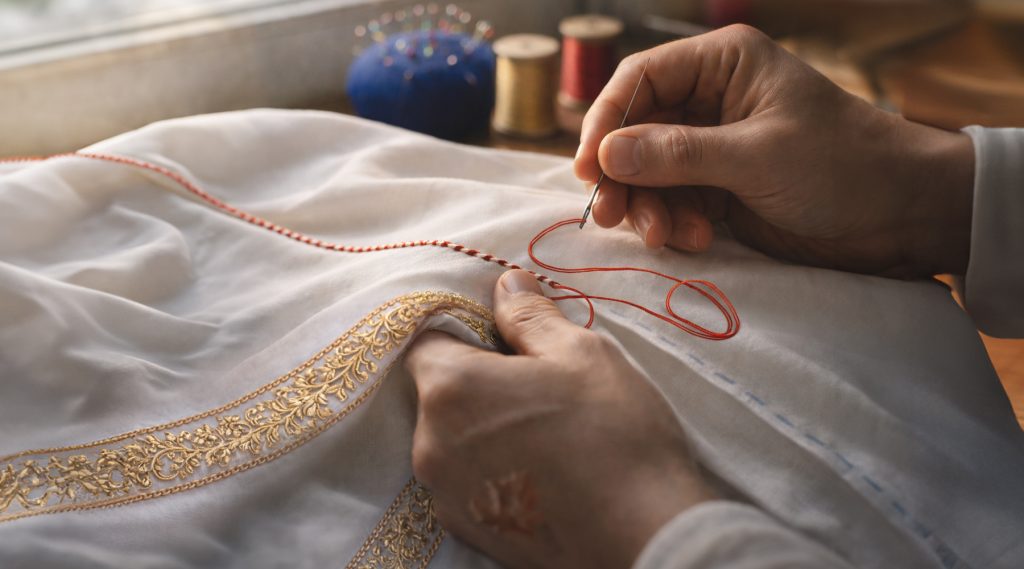
An Amazing Fact: In the vacuum of space’s extreme temperatures and near-nothingness, astronauts need special clothing to survive. Their spacesuits supply oxygen, maintain pressure, regulate body temperature, and remove humidity and carbon dioxide. Astronauts must place enormous trust in these suits—lifelines only fractions of an inch thick in places. It’s truly important, lifesaving clothing!
When it comes to clothing, humans are different from most other creatures.
Animals are usually “born with their clothes on.” Their coverings grow from the inside out, and many even shed and regrow them. Mankind alone must be clothed from the outside.
Scripture says our dependence on artificial clothing began after the fall: “Then the eyes of both of them were opened, and they knew that they were naked; and they sewed fig leaves together and made themselves coverings” (Genesis 3:7). The KJV uses the word “aprons”—meaning belts or girdles.
Relying on their own resourcefulness, Adam and Eve stitched fig leaves into belts to hide their shame. Having never witnessed death, they likely expected the leaves to serve as a lasting disguise, but as the leaves shriveled, the fallen pair’s homespun solution failed.
God showed them that true covering would require sacrifice: “For Adam and his wife the LORD God made tunics of skin, and clothed them” (v. 21). The Creator explained that the death of another living creature would be needed for them to be properly dressed. In contrast to their skimpy fig belts, God provided them with durable tunics. Humanity fashioned flimsy “miniskirts”; God supplied lasting robes of skin—signaling that sin’s shame cannot be covered by human effort.
Why Do We Wear Clothes?
Thus, clothing began as God’s gracious covering, but is clothing still an important biblical principle some 6,000 years later? Let’s explore this issue and see what we discover.
1. The reason why God instituted clothing was to cover Adam’s and Eve’s nakedness, which remains the main reason we wear clothing today: modesty.
Today’s fashion trends lean toward more exposure and less modesty. With scantily clad bodies featured on billboards and even on “family-friendly” websites, it’s easy for Christians to become desensitized and accept and even adopt immodest clothing in everyday life.
We must resist these trends, but especially when we come to worship the Lord! We need to ensure that everything we wear is high enough, low enough, and loose enough to cover our bodies, because we are in the presence of a holy God. Remember, the angels surrounding the throne of God, who minister in His presence, veil their faces and their feet and cry out, “Holy, holy, holy” (Isaiah 6:2, 3).
2. Another reason we wear clothing is to protect us from harsh weather and climates. In certain parts of the world, clothing is used to keep us warm; in other parts, it must keep us cool and protect us from excessive sun or wind.
When the apostle Paul was in prison, he knew that his remaining days were few. In a letter to his dear friend Timothy, he wrote, “The time of my departure is at hand. I have fought the good fight, I have finished the race, I have kept the faith” (2 Timothy 4:6, 7). At the end of the letter, he included several special requests: “Bring the cloak that I left with Carpus at Troas when you come—and the books, especially the parchments” (v. 13).
Back then, the only luxuries a prisoner might enjoy had to be supplied by friends and family. Paul was getting old, and he was susceptible to the cold. I deeply empathize when Paul says to bring his cloak quickly (v. 9), before winter! (v. 21). For me, it’s easier to endure heat than cold, so I’m thankful that God gave us clothing to protect us from the elements.
3. We also wear clothing as a show of respect. What we wear says something about what we are doing, where we are going, and whom we are planning to see.
Different clothing is appropriate for different occasions. For instance, you wouldn’t wear the same outfit to go picnicking with your family as you would to go work on a construction site. Likewise, when you come to worship before the Lord, you wouldn’t wear the same clothes that you’d don if going to the beach.
You might say, “It doesn’t matter what we wear to church, because God looks on your heart.” It’s certainly true that some congregants or guests might not be able to come in church-appropriate clothing; I hope they come anyway, because God will bless them!
But many congregants purposely come to church dressed as though the occasion were just a casual gathering, even if they have more appropriate clothing hanging in the closet. Most people, if invited to the governor’s house for dinner, wouldn’t wear jeans. How sad to show more respect for an earthly ruler than for the King of the universe! When we come before the Lord, we should wear our best—whatever it happens to be.
4. We also wear clothing as identification. For example, it’s essential to be able to recognize police officers, and they typically wear uniforms for that reason. When they are undercover, you can’t spot them in a crowd. If you were in trouble, you would have to rely on them noticing you.
During a war, it’s important for the U.S. soldiers to wear uniforms identifying them as Americans so that they don’t get hit by friendly fire.
In Bible times, Jacob gave Joseph a multicolored robe (Genesis 37:3), which was an ancient symbol of royalty reserved for special children. King David’s daughters also wore coats of many colors (2 Samuel 13:18), identifying them as royalty.
In the New Testament, John the Baptist stood out in the crowd because he wore simple, modest clothing, a stark contrast to the ornate attire favored by the religious leaders of his day. Mark 1:6 states that the prophet wore a robe made of camel hair and a belt of leather. The Jews who saw John were reminded of the prophet Elijah, who also wore a garment of hair and a leather belt (2 Kings 1:8).
It is said that you shouldn’t judge a book by its cover, but most people do. If a publisher wants a book to sell well, it had better have a good cover. Likewise, while people shouldn’t judge others merely by the clothes they wear, they likely will to some degree. So, as a Christian, you don’t want to wear anything that might identify you as someone who isn’t following Christ, because your witness may be compromised.
So, What Shall We Wear?
The Bible mentions several things we should remember to wear.
One thing that Christians should put on is a smile. I’m not kidding!
Job 9:27 says, “I will put off my sad face and wear a smile.” God’s people should want to put on a cheerful countenance. Many of us could do a lot more to advertise for Jesus simply by being happier. Too many Christians go around looking like they’ve been baptized in lemon juice; then they wonder why their friends and family aren’t interested in hearing their testimony. Many more seekers would want to be Christians if we looked joyful in our relationship with Jesus.
We also need to put on the armor of God. In Hans Christian Andersen’s “The Emperor’s New Clothes,” two swindlers flatter a vain ruler with fake fabric that’s “invisible” to anyone unfit or foolish. The emperor, unable to see it and anxious about his reputation, pretends to admire its supposed fine workmanship and colors. The fraudsters dress him in the “garments” and urge a public parade. Courtiers and townspeople, also fearing embarrassment, echo fake admiration. At last, a child blurts the truth: The emperor is wearing nothing at all.
When we talk about the armor of God, we are not describing imaginary clothes. Ephesians 6:11 says, “Put on the whole armor of God, that you may be able to stand against the wiles of the devil.” The Bible instructs us to wear the helmet of salvation, the breastplate of righteousness, the sword of the Spirit, the belt of truth, and the gospel of peace (vv. 14–17). Like He did in Eden, God supplies these garments for us—but you and I must make time to put them on each day.
We do this, for example, by putting the Word of God in our hearts and our minds and by taking it wherever we go. These various implements are exactly what Jesus used to combat the devil in the wilderness (Luke 4:1–13), and they are available to us.
If we’re going to be effective in helping Jesus save others, we need to be properly clad. Romans 13:12 tells us, “The night is far spent, the day is at hand. Therefore let us cast off the works of darkness, and let us put on the armor of light.” Jesus said that people ought to look at us and see that we have a light. “Let your light so shine before men, that they may see your good works and glorify your Father in heaven” (Matthew 5:16).
Do Our Clothes Matter?
In Matthew 22, Jesus tells a parable about a king who plans a wedding feast. It would have been understood by His listeners that when the king had to go out into the highways, byways, and hedges to call people to the wedding banquet, the people who would have responded were too poor to own suitable garments for a royal wedding.
Therefore, the king had to provide the clothing at his own expense.
Incredibly, however, someone showed up without the wedding garment. The person had no excuse (v. 12); he simply didn’t take the time to don the garment that had been provided. Consequently, “The king said to his servants, ‘Bind him hand and foot, take him away, and cast him into outer darkness; there will be weeping and gnashing of teeth’” (v. 13).
Likewise, we need to be wearing the right type of clothing when Jesus comes.
Husbands, love your wives, just as Christ also loved the church and gave Himself for her, that He might sanctify and cleanse her with the washing of water by the word, that He might present her to Himself a glorious church, not having spot or wrinkle or any such thing, but that she should be holy and without blemish (Ephesians 5:25–27).
You might be thinking, “How do I get garments that are without spots or wrinkles?”
In Revelation 3:18, Jesus says, “I counsel you to buy from Me gold refined in the fire, that you may be rich; and white garments, that you may be clothed, that the shame of your nakedness may not be revealed.” Our pure white garments come from Jesus. The great news is that He does not charge a price for them; salvation is a free gift (Romans 6:23). The Lord wants nothing but the gold of our faith and the silver of our love.
The next question you might have is, “Once I get the garment, how do I keep it clean?”
Revelation 7:14 gives us the answer. Our garments are washed in the blood of the Lamb. When you come to Jesus, He gives you a spotless white robe. This is justification, which means that you come to the Lord just as you are and He covers you with His perfect robe of righteousness.
What follows is sanctification, a process in which you learn how to keep that robe clean and during which your character is cleansed by the blood of the Lamb. Just remember that while His blood is readily available, we don’t want to carelessly soil the pure robes He gives us.
Take Action
Many of us have had easy access to a washer and dryer our entire lives. I’ve discovered that when you have these appliances at hand, you’re less likely to be particular about keeping your clothes clean.
One time when our washer and dryer broke at our cabin in the hills, I wore the same coverings for several days because I didn’t want to go to the trouble of washing them by hand. I was also more careful to keep my clothes clean.
I believe the Lord is now trying to teach us how to keep the spotless clothes He gives us forever clean. Many of us are waiting for some sort of special prescription to be handed out in the future that will enable us to live victorious lives, but that has already been given to us!
Today, the grace of Jesus is always available to wash away our sins when we ask Him. We often forget, however, that it won’t always be that way. A day is coming when Christ will proclaim that the laundromat is closed. “He who is unjust, let him be unjust still; he who is filthy, let him be filthy still; he who is righteous, let him be righteous still” (Revelation 22:11).
Perhaps, like me, you’re filled with amazement at God’s generosity and can’t comprehend how a life that has been so scarred and filthy can be suddenly washed and clothed in pure white. Remember that with God, all things are possible (Matthew 19:26).
Finally, the Bible says to …
· Put on the armor God has granted to you.
· Wear the white garments Jesus has given you.
God is inviting you to take action today—to don the things He has provided. In doing so, you will embody the characteristics of Christ and serve as a powerful witness to others of God’s love and mercy.
BONUS MATERIAL
The Bride and the Harlot. Two important women are mentioned in Revelation chapters 12 and 17. One woman represents God’s church, while the other represents a fallen church. Not once are they said to speak! Yet we can identify who they are because the Bible tells us what they are wearing (Revelation 12:1; 17:4, 5) and what they are doing (Revelation 12:2, 5, 6; 17:1–3, 6).
Kids, Culture, and Clothing. Having attended 14 schools, public and private, as a child, I noticed a clear pattern: Where uniforms were required, students spent less energy worrying about clothes and more on friendships and schoolwork. Uniforms lowered the social pressure to “dress to impress,” reduced distractions, and helped level the playing field. In today’s image-driven culture, that simple consistency can free kids to focus on what matters most: learning and character development.
Jehovah’s Gift. In the Old Testament, Saul’s son Jonathan, the crown prince, took off his armor, robe, and belt and gave them to David (1 Samuel 18:4). Jonathan means “Jehovah’s gift.” Isn’t it interesting that Jehovah’s gift gave David his armor and his robe, along with a sword and bow? Jesus gives us these same things to wear today!
Download the Magazine Today!
More on Inside Report

7 Reasons the Secret Rapture Isn’t Biblical
Download Inside Report Magazine Today! An Amazing Fact: In the early 1500s, the Aztec Empire…

Coming Soon: The Magnificent Kingdom
An Amazing Fact: Surveys reveal that about 75 percent of people in North America believe…

The Story Of Amazing Facts – 60 Years of Miracles
Download Inside Report Magazine Today! The Birth of the Ministry: 1965–1966 The story of Amazing…

Understanding End-Time Bible Prophecy
An Amazing Fact: Fortune tellers have long beguiled people, blending mysticism and entertainment through the…

The Holy Spirit: Exploring the Divine Mystery
An Amazing Fact: Every minute of every day, the earth is struck by approximately 6,000…