
Coming Soon: The Magnificent Kingdom
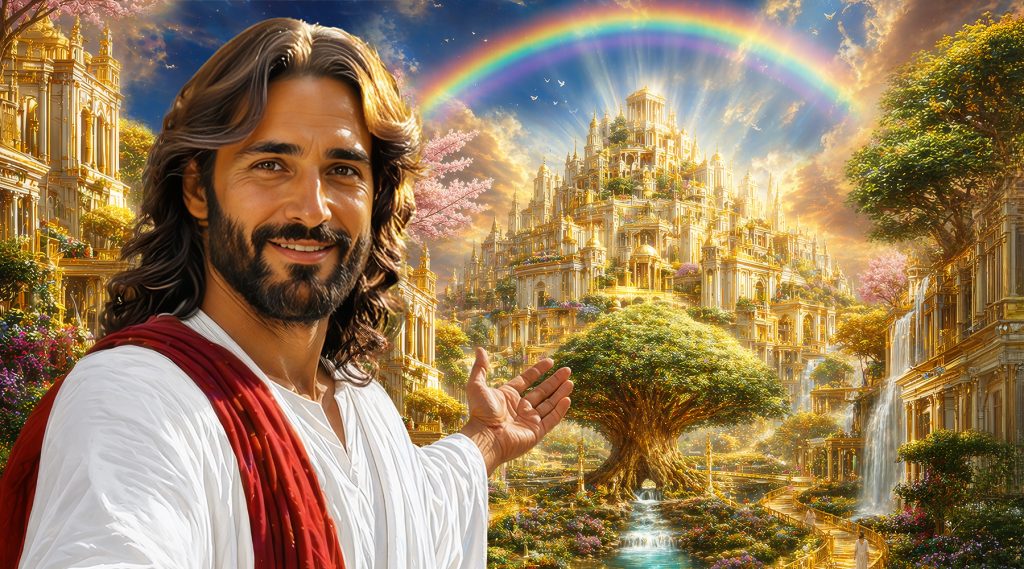
An Amazing Fact: Surveys reveal that about 75 percent of people in North America believe in heaven, but only about 23 percent believe in hell. Perhaps even more surprising, among those who believe in heaven, nearly 90 percent believe they’re going there. These statistics tell us something important about the human heart …
*****
Deep down, people sense that life has to lead to something better than the suffering and death we experience every day on this sin-sick planet. There is a longing inside us for a world that is healthy, joyful, and permanent.
Well, the Bible explains why: God “has put eternity in their hearts” (Ecclesiastes 3:11).
But while many people believe in heaven, there is much confusion about what it actually is.
Of course, popular culture typically mocks the idea of a Christian heaven—picturing people as ethereal beings with harps floating on puffy clouds or winged babies drifting through the sky. Still others think heaven is nothing more than a poetic idea meant to comfort people in difficult times.
The Bible, however, describes something far more concrete and wonderful. The word “heaven” appears hundreds of times, but when you focus specifically on the place where God dwells and where the redeemed will live, there are still well over a hundred passages.
Heaven is not imaginary. It is not merely symbolic. The Bible writers treat it as a real kingdom prepared by a real Savior for real people who love Him.
Jesus said plainly, “In My Father’s house are many mansions; if it were not so, I would have told you. I go to prepare a place for you” (John 14:2). Christ didn’t say He was preparing some vague spiritual experience. He said He was preparing a place. That means heaven is tangible. And if Jesus promised it, we can be certain it is true.
So let’s learn more about it …
A Glimpse of Heaven on Earth
In the Bible, one of the closest pictures of heaven is found during the reign of King Solomon. If you were to choose the moment when Israel experienced its greatest earthly glory, it would likely be during Solomon’s early years as king.
It was like a tiny moment of heaven on Earth.
The temple had just been built. Remember, God had told David that he could not build it because he had been a man of war, but Solomon, a name related to the word shalom, meaning peace, was allowed to complete it during a time of peace (1 Chronicles 22:8, 9).
Jerusalem was also flourishing with wealth and beauty. The Bible tells us that gold was everywhere, and silver became so plentiful that it was “accounted as nothing” (1 Kings 10:21). Israel enjoyed peace on every border, and people from distant nations came to learn about the God of heaven.
Among them was the famous Queen of Sheba. She traveled from a far country with a huge caravan loaded with spices, gold, and precious stones. Of course, she did not come merely to admire the beauty. She also wanted to discover the source of Solomon’s wisdom.
Still, the Bible says that when she saw the temple, the palace, and the orderly service of Solomon’s kingdom, “there was no more spirit in her” (1 Kings 10:5). In other words, she was left breathless! Everything she had heard about Solomon was impressive, but the reality was far greater.
She finally exclaimed, “Indeed the half was not told me” (1 Kings 10:7). That reminds me of 1 Corinthians 2:9: “Eye has not seen, nor ear heard, nor have entered into the heart of man the things which God has prepared for those who love Him.”
A City Prepared by God
The Bible often describes heaven as a city. Indeed, it tells us plainly that God “has prepared a city for them” (Hebrews 11:16).
That can be jarring, because when we think about cities, we imagine traffic, noise, crime, worldliness, and pollution. We see it clearly—when large numbers of selfish people gather in one place, there will be endless problems. The challenge with cities isn’t the planning or architecture; it’s sin!
In heaven, there will be no greed, no violence, and no injustice. Imagine a city where every citizen loves God supremely and loves their neighbor as themselves. That is the kind of city that John saw while in vision: “I, John, saw the holy city, New Jerusalem, coming down out of heaven from God” (Revelation 21:2).
Notice he calls it New Jerusalem. It means “city of peace” (again, from shalom). Jerusalem was the center of worship for God’s people. It was where the temple was, the place where the presence of God was symbolically revealed. The New Jerusalem represents the ultimate fulfillment of God’s plan—a place where peace will finally reign. After thousands of years of conflict and suffering, God’s redeemed people will live in a true “city of peace,” where sin and sorrow will never enter again.
The Glorious City
Scripture provides several fascinating details about this city.
For one, Revelation says the city measures “twelve thousand furlongs” in length, width, and height (Revelation 21:16). In modern terms, that’s about 1,500 miles in perimeter, or about 375 miles on each side. That’s bigger than New Mexico! And because the city is described as a cube—with equal length, width, and height—it may rise 375 miles high. Whatever the exact dimensions, the message is clear: God’s kingdom will be vast, and there will be plenty of room for all who accept Christ’s invitation.
John also writes that this city has “a great and high wall with twelve gates, and twelve angels at the gates” (v. 12). Notice that the number twelve appears repeatedly in the description—twelve gates, twelve foundations, and the names of the twelve apostles written on them.
This is not accidental. Throughout Scripture, the number twelve is connected with God’s people and His kingdom. In the Old Testament, God built the nation of Israel around twelve tribes, the descendants of Jacob’s sons. In the New Testament, Jesus chose twelve apostles to represent the foundation of His church. The New Jerusalem reflects that same divine order. The city represents the complete family of God—the redeemed from every generation who have followed Him.
Some Bible students note that twelve divides evenly in many ways—by two, three, four, and six—making it an ideal number for construction and organization. God is a Creator of order, not confusion (1 Corinthians 14:33). The repeated use of twelve in the New Jerusalem reminds us that heaven will be a place of perfect structure, balance, and unity among God’s people.
The Bible reveals that each gate is made of a single pearl: “The twelve gates were twelve pearls: each individual gate was of one pearl” (Revelation 21:21). A pearl is created when a tiny grain of sand or another irritant enters an oyster. The oyster responds by covering that irritation with layers of a beautiful substance until, over time, it becomes a pearl.
In a sense, a pearl is born out of suffering.
Likewise, sin entered this world like a painful irritation in God’s perfect creation. But through the sacrifice of Christ, that tragedy is being transformed into something glorious. Just as the oyster covers the irritation and produces a pearl, Jesus covers our sin and produces redemption.
It is fitting, then, that the gates of the New Jerusalem are made of pearl. Every person who enters that city will do so because of the sacrifice of Christ. The gates themselves will stand forever as a reminder that heaven is possible only because Jesus paid the price for our salvation.
I also love this detail: “The street of the city was pure gold, like transparent glass” (v. 21). In this world, men fight wars over gold. They hide it in vaults. But in heaven, God uses pure gold as paving material. That should remind us that the things we treasure most on Earth are not nearly as valuable as we might believe.
The River and the Tree of Life
Flowing through the New Jerusalem is something even more beautiful than golden streets: “He showed me a pure river of water of life, clear as crystal, proceeding from the throne of God and of the Lamb” (Revelation 22:1).
All life depends on water. Without it, nothing survives. In the earth made new, the source of life will be this magnificent river flowing from God’s throne. No wonder Jesus calls Himself the water of life—a source of life-giving spiritual hydration (John 4:14).
Along the banks of this mighty river grows the tree of life. “On either side of the river, was the tree of life, which bore twelve fruits, each tree yielding its fruit every month” (Revelation 22:2). Again, notice the number twelve!
This is the same tree Adam and Eve were forbidden to eat from after sin entered the world. Humanity was driven from Eden so they would not eat from the tree of life and live forever in sin (Genesis 3:22–24). But the story comes full circle in Revelation. The redeemed are restored to the garden and once again receive access to the tree of life. “Blessed are those who do His commandments, that they may have the right to the tree of life, and may enter through the gates into the city” (Revelation 22:14).
Why is one tree accessible from both sides of the river? The picture John describes seems to be a marvelous tree that spreads across the riverbank, arching over the water so that its branches extend to both sides. I believe this is meant to convey that the tree will be accessible to everyone in God’s kingdom. No one will be excluded from the gift of eternal life.
John also says, “The leaves of the tree were for the healing of the nations” (Revelation 22:2). This does not mean people will become sick in heaven. Rather, it symbolizes the complete restoration of humanity. The divisions that now separate nations—race, language, politics, and culture—will be healed forever. The redeemed from every nation will be one family under God.
A World Without Suffering
One of the most comforting promises about heaven appears in Revelation 21:4: “God will wipe away every tear from their eyes; there shall be no more death, nor sorrow, nor crying.”
Think about the sorrow that fills our world today—hospital rooms, funerals, broken relationships, and painful memories. The Bible says those things will not exist in God’s kingdom.
Isaiah describes it in vivid language: “Then the eyes of the blind shall be opened, and the ears of the deaf shall be unstopped. Then the lame shall leap like a deer” (Isaiah 35:5, 6).
Those who have never seen will behold the beauty of God’s creation. Those who could not hear will listen to the songs of angels. Those who were crippled will run and leap with joy.
Another promise declares, “The inhabitant will not say, ‘I am sick’” (Isaiah 33:24). Imagine a world with no disease, no hospitals, and no pain. The Bible calls heaven a place where these “former things have passed away” (Revelation 21:4).
This restoration will also include the animal kingdom. Isaiah paints a remarkable picture of harmony among creatures that today are enemies: “The wolf also shall dwell with the lamb, the leopard shall lie down with the young goat, … and a little child shall lead them” (Isaiah 11:6).
The prophet continues by saying that even the lion will eat straw like the ox (v. 7). The violence and fear that dominate nature today will disappear when God restores the earth to its original condition. Nothing will hurt or destroy in God’s kingdom (v. 9).
Glorified Bodies
Sometimes people imagine heaven as a ghostlike existence where we drift around without real bodies, but the Bible teaches something very different.
When Jesus rose from the dead, He appeared to His disciples and invited them to touch Him. He said, “A spirit does not have flesh and bones as you see I have” (Luke 24:39). Christ even ate food with them to demonstrate that He was truly tangible. The apostle Paul explains that believers will receive a body like Christ’s resurrected body. “The Lord Jesus Christ … will transform our lowly body that it may be conformed to His glorious body” (Philippians 3:20, 21).
In heaven, we will not be disembodied spirits. We will live, eat, walk, talk, and explore the wonders of God’s creation in perfect, immortal bodies.
People often wonder whether we will recognize our loved ones in heaven with brand-new bodies. The Bible strongly suggests that we will. Paul writes, “Now I know in part, but then I shall know just as I also am known” (1 Corinthians 13:12).
Heaven will not diminish our understanding; it will enhance our discernment. The redeemed will have clearer minds and deeper insight than ever before. Reunion with family and friends who love Christ will be one of the greatest joys of eternity.
The Greatest Joy of Heaven
Golden streets, the river of life, and perfect health are wonderful promises. Yet the greatest blessing of heaven is even more profound.
Revelation declares, “God Himself will be with them and be their God” (21:3).
For thousands of years, sin has separated humanity from the direct presence of God. But in the new earth, that separation will be gone forever. The redeemed will see their Creator face to face and dwell in His presence. “In Your presence is fullness of joy; at Your right hand are pleasures forevermore” (Psalm 16:11).
The Bible also gives a solemn promise. Revelation says that nothing sinful will enter the city: “There shall by no means enter it anything that defiles” (Revelation 21:27). Sin is what brought suffering into the universe. God would never allow it to rise again.
That is why Jesus came to this world—to forgive sin and transform lives. When a person accepts Christ, the Bible says they become a new creation (2 Corinthians 5:17). God begins preparing them for the kingdom He has promised.
Jesus summarized the secret of life in one simple instruction: “Seek first the kingdom of God and His righteousness” (Matthew 6:33). When we make God’s kingdom our first priority, everything else falls into its proper place.
A Glorious Finale
The Bible’s story begins in a beautiful garden, where happy humans listened to an evil serpent and lost access to the tree of life. It ends with the serpent destroyed and paradise restored, where the redeemed once again eat from that tree and live forever.
In between those two scenes stands the cross of Christ, where Jesus gave His life so we could enter that eternal kingdom.
The good news is that God wants every one of us to be there. Heaven is not reserved for an elite few. It is offered to anyone, to whosoever will trust Christ and follow Him. Will you accept that heavenly invitation? When you finally walk through those gates of pearl and stand inside the city of God, you may look around in wonder and say the same words the Queen of Sheba once spoke: “The half was not told me.”
Download the Inside Report Magazine Today!
More on Inside Report

7 Reasons the Secret Rapture Isn’t Biblical
Download Inside Report Magazine Today! An Amazing Fact: In the early 1500s, the Aztec Empire…

Clothed by Christ: Dressing for Success
What kind of clothing will matter most when Jesus comes? And are you dressed for…

The Story Of Amazing Facts – 60 Years of Miracles
Download Inside Report Magazine Today! The Birth of the Ministry: 1965–1966 The story of Amazing…

Understanding End-Time Bible Prophecy
An Amazing Fact: Fortune tellers have long beguiled people, blending mysticism and entertainment through the…

The Holy Spirit: Exploring the Divine Mystery
An Amazing Fact: Every minute of every day, the earth is struck by approximately 6,000…